Outdoor-rated vs direct-burial Cat6: which one your run needs
The two boxes look alike and the copper inside is the same. The jacket isn't, and that decides whether your barn link lasts ten years or one wet spring.
Research-based, not tested on a farmWorks with any internet provider at the house.
Key takeaways
- Underground, with or without conduit: buy cable sold as direct burial (gel-filled or water-blocking tape).
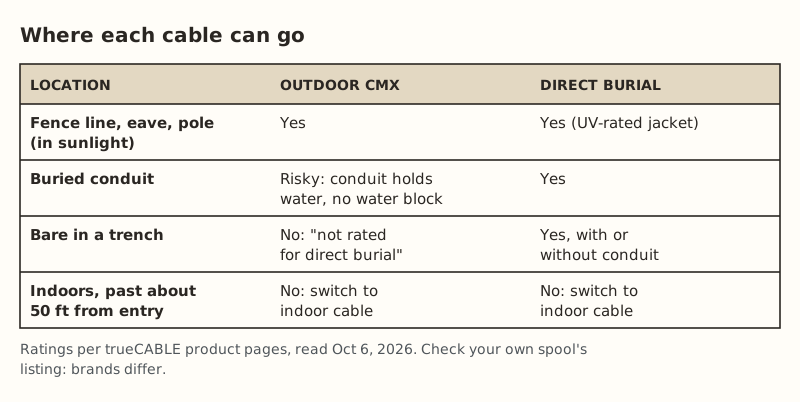
- Outdoor-rated (CMX) cable is for sunlight above ground: fence lines, eaves, poles. Makers mark it not rated for direct burial.
- Conduit doesn't make outdoor cable safe underground. Buried conduit collects water.
- Both types should change to indoor cable within about 50 ft of entering a building. Check with your inspector.
- If outdoor cable is already in the ground and working, test it now and plan to replace it. Don't trust it for the long haul.
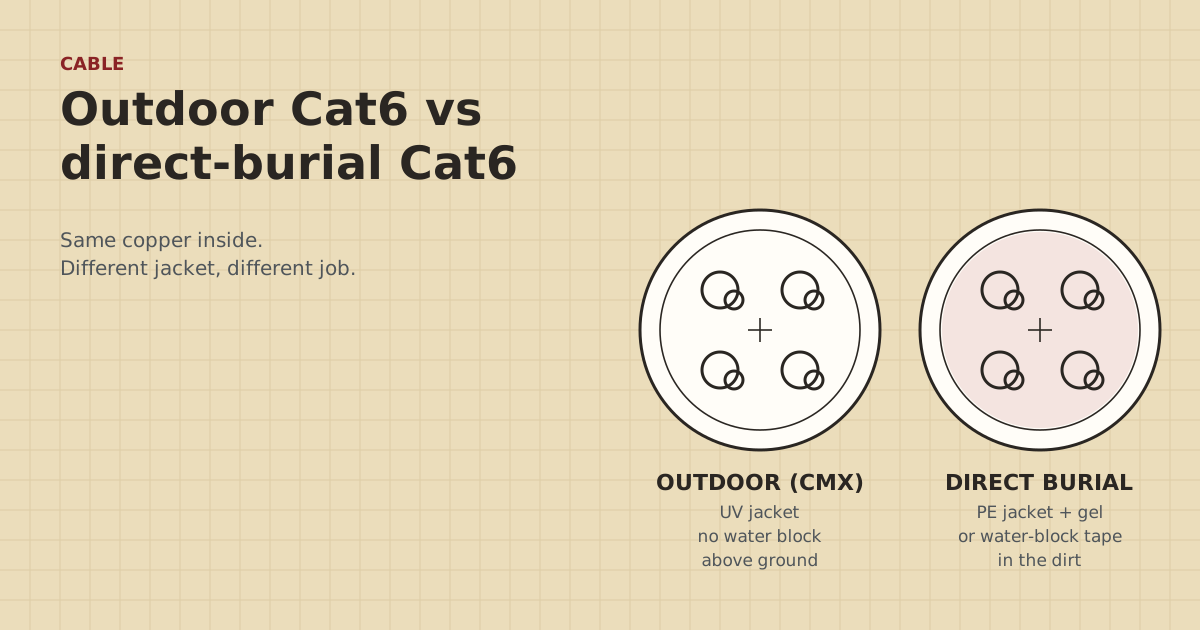
If the cable goes underground, buy direct-burial Cat6. That’s true with or without conduit. Outdoor-rated Cat6 (usually marked CMX) has a jacket made for sunlight and weather above ground. Makers mark it “not rated for direct burial”, and it has no water blocking for a wet conduit. The copper inside the two is often identical. The jacket and what’s packed around the pairs are what differ.
The rest of this post is how to tell them apart, where each one belongs, what the price gap looks like, and what to do if the wrong cable is already in the ground.
What’s different inside the jacket
Open both cables and you’ll see the same thing: four twisted pairs of solid copper. The difference is the protection around them.
- Outdoor (CMX) Cat6 has a UV-resistant outer jacket. trueCABLE describes its outdoor cable as made “for above ground applications”, with a jacket built to withstand sunlight, snow and ice. Its product page says plainly: “Not rated for direct burial.”
- Direct-burial Cat6 uses a polyethylene (LLDPE) outside-plant jacket plus water blocking: gel packed around the pairs, or water-blocking tape. That stops water from wicking along the inside of the cable if the jacket gets nicked. trueCABLE rates its version “suitable for direct burial with or without conduit.”
Water is what kills cable underground. A buried jacket sees constant damp, freeze-thaw, roots and the odd shovel. Once water gets into a non-blocked cable it travels along the pairs. Over months that shifts the electrical properties until the link slows, drops to 100 Mbps, or quits. That’s why makers add the gel or tape.
How to tell which one you have
Look at the print on the jacket and the box, not the color. Both are usually black.
| What you see | What it means |
|---|---|
| “Direct burial”, “DB”, “gel-filled”, “water-blocking tape” | Made for underground. Good to bury. |
| “CMX”, “outdoor”, “UV-resistant”, “OSP” with no burial wording | Above-ground outdoor cable. Don’t bury it. |
| “CMR”, “CMP”, “riser”, “plenum”, “CM” only | Indoor cable. Not for outside at all. |
| “CCA” or “copper-clad aluminum” | Not solid copper. Avoid for long runs and PoE. |
| Sticky gel when you strip the end | Gel-filled direct-burial cable. Wipe it off before terminating. |
Our parts data has a warning worth repeating: some cable sold as “direct burial” isn’t gel-filled. Check that the listing says gel-filled or water-blocking. If it only says “outdoor” and “direct burial” with nothing about how water is kept out, ask the seller or pick another brand.
Where each one belongs on a farm
Outdoor CMX cable is the right buy for:
- Runs stapled along a fence line, a barn wall or under an eave.
- The drop from a wireless bridge radio down a pole or gable to the building entry.
- Aerial runs on a messenger wire between buildings. Those need extra care with lightning; see the storms guide.
Direct-burial cable is the right buy for:
- Any trench, bare or in conduit.
- Runs that go underground for part of the way and up a wall for the rest. Many direct-burial jackets are also sun-resistant, so one cable can do both. trueCABLE says its direct-burial jacket withstands sunlight. Confirm that on your spool’s listing.
Neither should run far inside a building. trueCABLE’s outdoor cable FAQ says you can bring it up to 50 ft inside before it has to end or change to an indoor cable type. Treat direct-burial cable the same way. In practice, put a keystone jack, a patch panel or an outdoor surge protector right where the cable enters, and use regular indoor patch cable from there to the switch. Local code decides the exact rule, so ask the inspector if one is involved.
The price difference on a real run
Here are the spool prices from our parts data, checked Oct 5, 2026:
| Cable | Spool | Price range |
|---|---|---|
| Direct-burial Cat6 (gel-filled) | 500 ft | $149.99 |
| Direct-burial Cat6 (gel-filled) | 1,000 ft | $269.99–$349.99 |
| Outdoor CMX Cat6 | 1,000 ft | $224.99–$277.99 |
Worked example: a 260 ft barn run. Add about 10% for bends and 10 ft of slack at each end, and you need roughly 306 ft of cable. A 500 ft spool of direct-burial cable covers that with enough left to redo an end or run a second cable to a gate camera. The only priced outdoor spool in our data is 1,000 ft, so going “cheaper” with outdoor cable would actually mean buying more cable than you need, for a cable you can’t bury.
Even on a 1,000 ft spool, the gap between outdoor and direct burial is small compared with a second trench. Renting a trencher, or a long day with a shovel, costs more than the difference. Buy the cable that’s rated for where it’s going.
Other parts that go with either cable:
- Conduit (optional): 1 in Schedule 40 PVC was $9.53–$10.75 per 10 ft stick.
- Termination tools: plugs, a ratcheting crimper and a basic tester came to $114.96–$199.43 if you buy all three. Test the cable on the spool before it goes in the ground.
- Surge protection: an outdoor Ethernet surge protector at each building, $11.69–$14.14 each. A copper run between two buildings ties their grounds together, so it needs protecting at both ends.
Conduit or bare in the ground?
Direct-burial cable doesn’t need conduit. Here’s when conduit is still worth the money and effort:
| Situation | Conduit? | Why |
|---|---|---|
| Soft soil, short run, unlikely to change | Optional | The cable is rated for bare burial |
| You might add a camera cable or fiber later | Yes | Pull new cable without digging again |
| Rocky fill, roots, or gophers | Yes | Protects the jacket from abrasion and chewing |
| Crossing a driveway or lane with trucks | Yes, Schedule 40 or heavier | Spreads the load and lets you replace the cable |
| Cable climbs out of the ground up a wall | Yes, for the exposed section | Protects against mowers, string trimmers and livestock |
Whichever you choose, the conduit isn’t a waterproof pipe. It will have water in it at some point. That’s the whole reason not to put outdoor cable in it.
Call 811 a few business days before any trench. It's free. Burial depth for data cable isn't settled by a source we could verify. One cable maker suggests 18–24 in bare and 8–10 in in conduit, but your local inspector has the final say. If the trench runs near power lines, or you want power and data in the same trench, talk to a licensed electrician first.
I already buried outdoor cable. Now what?
It happens a lot. The cable was on the shelf, the box said “outdoor”, and the trench was open. Here’s what to do.
- Test it now. Plug a laptop into the far end and check the link speed it negotiates (1 Gbps or 100 Mbps). Run a speed test over the link. Write down the result and the date.
- Watch for the warning signs. The link drops to 100 Mbps, drops out after rain, or PoE devices at the far end reboot. Those usually mean water is getting in or a pair is going bad. The barn link troubleshooting guide walks through each one.
- Plan the replacement on your schedule. If it’s in conduit, pull a direct-burial cable through using the old one as the pull line. Tie the new cable to the old one and pull slowly. Leave a pull string in the conduit for next time. If it’s bare in the ground, the replacement means a new trench. Do it when the ground is easy to dig, not in a frozen January with cameras down.
- Consider fiber for the replacement if the run is long or the area gets a lot of lightning. Fiber can’t carry a surge between buildings. See single-mode or multimode fiber.
Common mistakes
- Burying indoor cable. CMR or CMP cable from a house job has neither a UV jacket nor water blocking. It’s the worst choice underground.
- Buying copper-clad aluminum (CCA). It’s cheaper, but it has more resistance than solid copper. That hurts long runs and heats up with PoE. Look for “solid bare copper” on the listing.
- Leaving gel on the conductors. Wipe the gel off with a dry rag before you terminate. Don’t use a solvent that could swell the insulation.
- No drip loop. Where the cable comes out of the ground and into a wall, let it dip below the entry hole so water runs off instead of following the cable inside.
- Forgetting the 328 ft limit. No cable rating changes the copper Ethernet limit of 100 m (328 ft) end to end. Past that, see wireless bridge or a long cable.
What we don’t know
We haven’t found a code source that sets a burial depth for low-voltage data cable. NEC Table 300.5 covers power wiring, and the depth numbers that get quoted for data cable come from cable makers. We also can’t promise how long outdoor cable lasts in a conduit. It depends on soil, drainage and climate, and no maker publishes a number for a use they don’t rate it for. Brands differ too. Read your spool’s listing and treat this post as a guide to what to look for, not a rating for any specific product.
Next step
Measure your route, add slack, and pick the spool size from the table above. Then follow the under-300-ft recipe for trench depth, testing on the spool and surge protection at both ends. If you’re not sure cable is even the right method, start with how to get internet to a barn.
Go deeper
This post answers one question. The full guide covers the rest: Under 300 ft: buried Cat6 (direct burial vs conduit, the 328 ft limit, testing before you bury, surge protection).
Questions people ask
Can I bury outdoor-rated Cat6 cable?
Can I put outdoor Cat6 in conduit underground?
Is direct-burial Cat6 UV resistant?
Do I need conduit for direct-burial Cat6?
How deep should I bury direct-burial Cat6?
Can I run direct-burial cable inside the house?
Sources
- trueCABLE: Cat6 Outdoor Unshielded CMX (product page), retrieved Oct 6, 2026
- trueCABLE: Cat6 Direct Burial Ethernet Cable (product page), retrieved Oct 6, 2026
- trueCABLE: A Guide to Cat6A Unshielded Direct Burial Ethernet Cable, retrieved Oct 5, 2026
- 811 Before You Dig (Common Ground Alliance), retrieved Oct 5, 2026
- Category 6 cable - Wikipedia, retrieved Oct 5, 2026
- Cabling Installation & Maintenance: Ground potentials and damage to LAN equipment, retrieved Oct 5, 2026
- Voltive V-1236-1 Cat6 Direct Burial Gel Filled, 500 ft, retrieved Oct 5, 2026
- trueCABLE Cat6 Gel Filled Direct Burial, unshielded, 1000 ft, retrieved Oct 5, 2026
- JM Eagle 1 in. x 10 ft PVC Sch 40 Conduit 67462, retrieved Oct 5, 2026
- ETH-SP-G2, retrieved Oct 5, 2026
- FS.com Cat6 shielded pass-through RJ45, 50/pack (144309), retrieved Oct 5, 2026
Prices on this page are US retail ranges for named example parts, checked on the date shown, before tax and shipping. They change often.
Independent · not affiliated with SpaceX or Starlink. Links to Starlink’s plan pages use the site owner’s own referral link (your price is the same); there are no affiliate links (how we make money). It is general information, not electrical advice: where code applies, use a licensed electrician. Found an error? Tell us.