Checking line of sight from the house to the barn without special tools
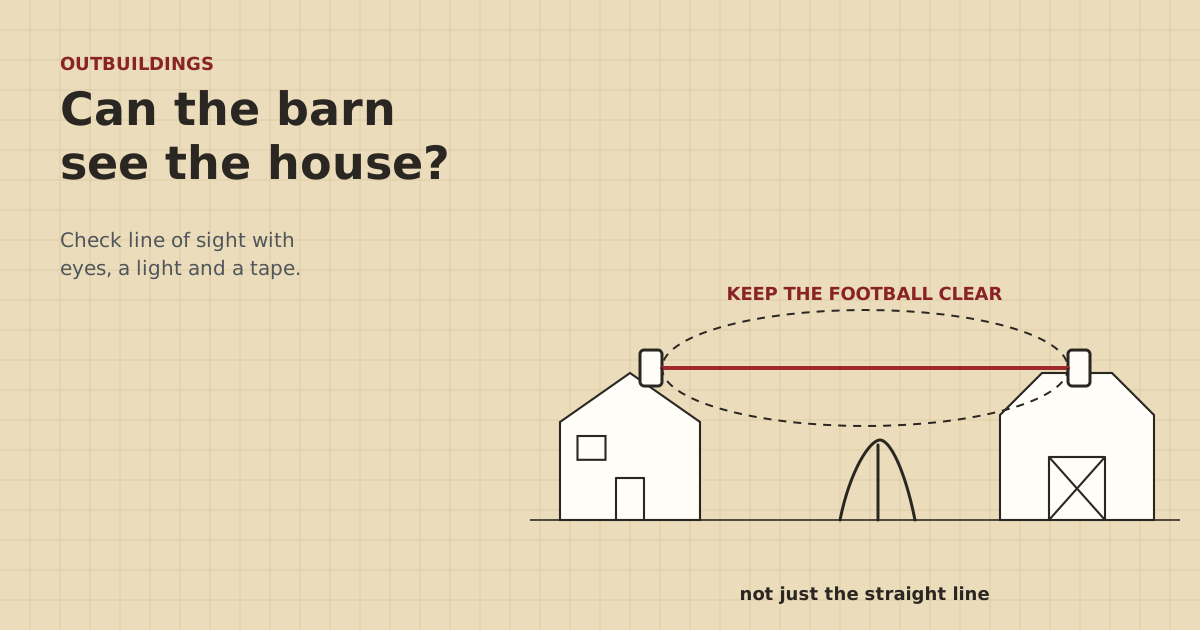
Seeing the barn from the porch isn't the test. The radios need a clear football-shaped space between them, at the height you'll mount them, in the season with the most leaves.
Research-based, not tested on a farmWorks with any internet provider at the house.
Key takeaways
- Check from the two exact spots where the radios will mount, at that height. Ground level tells you little.
- The straight line isn't enough. Keep at least 60% of the Fresnel zone, a football-shaped space around the line, clear of trees, roofs and rises.
- At 5 GHz the zone is about 5 ft wide at the middle of a 500 ft link (radius). Branches inside it slow the link even when you can see the barn.
- A flashlight or a mirror at dusk, a pair of binoculars and a phone map answer most cases for free.
- Check in full leaf, or assume the trees will fill in. Winter checks look better than summer will.
Stand at each spot where a radio will mount, at the height it will mount, and look at the other spot. If nothing crosses the line or comes close to it, check the space around the line too: radio planners keep at least 60 % of the Fresnel zone, a football-shaped space around the line, clear. At 5 GHz that zone is about 5 ft in radius at the middle of a 500 ft link. A flashlight at dusk, binoculars and a phone map are all the tools you need. Do it in full leaf if you can.
That’s the short version. Below is how to do each check, the numbers for common barn distances, and what to do when the answer is “almost”.
Why “I can see the barn” isn’t enough
Most people check line of sight by standing on the porch and looking at the barn. That tells you two things that don’t matter much: what’s visible from 5 ft off the ground, at the porch, today.
The radios care about three different things:
- The real mount spots. A radio under the house eave at 14 ft sees over the pickup, the fence and the garden shed. A radio on the barn’s gable end sees over the cattle panels. Your eyes on the porch don’t.
- The space around the line. A radio signal isn’t a laser. It spreads into a football-shaped space between the two radios, called the first Fresnel zone. If too much of that space is filled with leaves, a roof edge or a rise in the ground, the link gets slow or drops, even when the straight line is clear.
- The worst season. Trees and leaves add noticeable loss at 2.4, 5 and 6 GHz. A link that looks open across bare branches in March can be half blocked in July.
So a good check is one done from the right spots, that looks at the whole football, and that accounts for leaves.
The numbers: how wide the football is
The first Fresnel zone is widest at the middle of the link. Here is the formula radio planners use. Midpoint first-Fresnel radius: F1[m] = 8.656 x sqrt(D[km] / f[GHz]); F1[ft] = 36.03 x sqrt(D[mi] / f[GHz]). You don’t need to do the math. Here it is for common barn distances at 5 GHz, the band most short bridge pairs use:
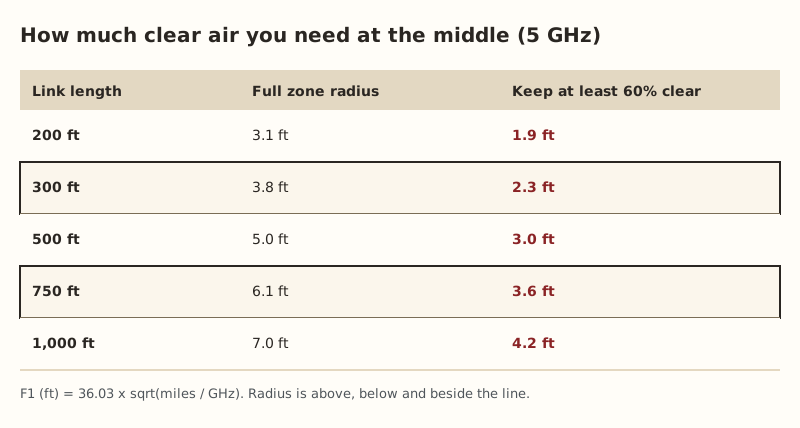
How to read it: on a 500 ft link, the football is about 5 ft in radius at the middle. To keep at least 60 % of it clear, you want about 3 ft of open air above, below and beside the straight line at the halfway point. Near each radio the football narrows to almost nothing, which is why a branch right next to a radio matters less than one halfway across.
Two things follow from the table:
- Longer links need more height. At 1,000 ft you want about 4 ft of clear air below the line at the middle, plus whatever the ground rises.
- The middle is where trouble lives. A hay stack, a machine shed or a tree line halfway across is the most likely thing to cut into the zone.
Higher-frequency bridges have a narrower football. A 60 GHz link is much thinner, but it has its own problem: it’s very directional, and even rain can weaken it. Ubiquiti pairs its 60 GHz bridge with a 5 GHz backup radio for that reason.
Check 1: Measure the real distance
Measure from mount spot to mount spot, not building to building.
- Phone map: open the satellite view in a maps app and use its measure-distance tool. Drop one point on the house wall where the radio will go and one on the barn wall. This also shows you tree rows, buildings and equipment parking along the line.
- Walk it: a measuring wheel or a long tape is better if the map is old or the trees have grown.
Write the number down. It decides which row of the table you use, and whether a bridge is even the right method. Under 328 ft along a route you can dig, a buried cable is usually simpler; the bridge vs cable comparison walks through that choice.
Check 2: Look from both mount spots
Get to the mount height at each end. That might mean a ladder against the eave, a second-floor window, or the hay loft door.
From each end:
- Look at the other mount spot. Use binoculars past a few hundred feet. Can you see the exact spot, not just the building?
- Look along the line. What’s under it? Note anything near the middle: trees, a rise in the pasture, a grain bin, a roof ridge, power lines.
- Estimate the clearance at the middle. Pick the object closest to the line near the midpoint. How far below the line is its top? Compare with the table. If the line passes 6 ft over a tree row on a 500 ft link, you’re fine. If it passes 2 ft over, you’re inside the football.
Doing it from both ends matters. A branch can be hidden behind a roof edge from one side and obvious from the other.
Use a ladder rated for your weight, set it on firm ground, and have someone hold it. Stay at least 10 ft from overhead power lines with you, the ladder and any mast. If the only good mount spot is near the service drop, ask the power company or a licensed electrician first.
Check 3: The flashlight or mirror test
This is the easiest way to confirm the line, and it’s free.
- At dusk, have a helper stand at the barn mount spot with a bright flashlight pointed at you. If you can see the light from the house mount spot, the straight line is open.
- On a sunny day, a small mirror does the same job. Your helper flashes sunlight back toward you.
- Talk by phone while you do it, so the helper can move the light up and down. If the light disappears when they lower it 3 ft, you know how much margin you have.
The light only proves the straight line. You still have to judge the football around it by eye.
Check 4: Height, and how much more you need
If something is inside the football, the cheapest fix is almost always height at one or both ends.
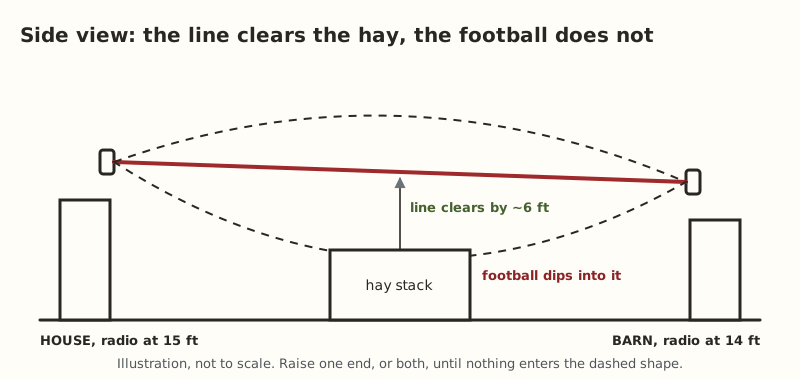
A rough way to work out how much to add:
- Find the obstacle’s height near the middle, and how far below the line its top is.
- Look up the “keep clear” number in the table for your distance.
- If the gap is smaller than that number, raise the radios by the difference (raising both ends by that amount raises the middle of the line by the same amount).
Example: a 700 ft link with a row of round bales stacked about 9 ft high at the middle. Both radios at 12 ft put the line 3 ft over the bales. The table says keep about 3.5 ft clear at 750 ft. Raise both radios by a foot or two, or raise one end by about three feet, and you’re clear. A short mast on the barn gable often does it.
When the obstacle is a tree line, height has limits. Mature trees grow taller every year, and a pole tall enough to clear them needs proper footing and guying. At that point, look for a path around the trees, a relay spot that sees both ends, or a cable. The bridge recipe covers relay hops, and the beyond-1,000-ft recipe covers fiber.
Check 5: Leaves and seasons
If you’re checking in winter, assume summer will be worse. Look at each tree near the line and ask how far its branches spread in leaf. Deciduous trees can fill several feet of air that looks empty in February.
Good ways to account for it:
- Check again in June or July before you mount anything permanent, if the timing works.
- Add margin. If a tree is near the line in winter, treat it as inside the football in summer.
- Ask about growth. A young tree row along a fence will be taller in five years.
Worked examples
Hay barn, 450 ft, open pasture. Radios at 12 ft on both buildings. The pasture is flat. Clear-zone need at the middle is under 3 ft. Nothing is near the line except cattle and the occasional tractor, which are well under 12 ft. This one passes. A short-range pair ($108–$139.99 (checked Oct 5, 2026)) fits.
Shop, 600 ft, a creek with willows halfway. From the porch you can see the shop over the willows. From the eave at 13 ft, the willow tops look about 2 ft under the line in winter. The table says keep about 3.3 ft clear at 600 ft, and the willows will leaf out. This fails. Options: a 10 ft mast on the shop to raise that end, a different mount spot that bends around the willows, or a relay on a pole the creek doesn’t affect.
Second house, 1,000 ft, slight rise in the middle. The rise puts the ground about 6 ft higher at the midpoint. With radios at 15 ft on both houses, the line is 9 ft over the rise. Keep-clear is about 4.2 ft. You have margin. At this distance, look at a long-range pair ($142–$218 (checked Oct 5, 2026)) so the link isn’t working at its edge.
Common mistakes
- Checking from the ground. The answer at 5 ft is not the answer at 14 ft, in either direction.
- Checking only the straight line. The flashlight test passes, the link still struggles, because a branch sits inside the football.
- Checking in winter only. Leaves are the most common reason a bridge that worked in spring is slow by summer.
- Ignoring the middle. People worry about a branch near the radio and miss the hay stack halfway across.
- Forgetting future changes. A new grain bin, a hay stack that moves every season, or a tree row that’s still growing.
- Mounting on something that sways. A thin mast or a gutter bracket can move the radio enough to lose aim in wind. See the bridge keeps rebooting for other causes of a link that drops.
What we don’t know
We can’t see your property, so we can’t tell you whether your link will work. The table is the textbook midpoint radius at 5 GHz; real links also depend on the specific radios, interference from nearby equipment and the exact shape of your trees. The site owner hasn’t done line-of-sight checks on a farm. Owner-run tests at home, like a bridge pair across a yard, will be posted on the gear tests page and labeled as such.
Next step
Measure the distance mount to mount, check from both ends at mount height, do the flashlight test, and compare your clearance with the table. If it passes, the 300 to 1,000 ft bridge recipe takes you through mounting, aiming and power. If you have several buildings, put each one through the Outbuilding Link Planner with “clear”, “trees” or “hill” as the line-of-sight answer.
Go deeper
This post answers one question. The full guide covers the rest: 300 to 1,000 ft: point-to-point wireless bridge (line of sight, Fresnel zone, mounting, aiming and power).
Questions people ask
How do I know if two buildings have line of sight?
What is the Fresnel zone in plain words?
How much clearance do I need for a 500 ft wireless bridge?
Can I check line of sight with Google Maps or Google Earth?
Will a wireless bridge work through a few trees?
Does the curve of the earth matter between farm buildings?
Sources
- Fresnel zone (Wikipedia: clearance guideline and midpoint radius formula), retrieved Oct 6, 2026
- Ubiquiti UISP airMAX NanoBeam 5AC tech specs, retrieved Oct 6, 2026
- Interline: Fresnel Zone, Link Clearance and Signal Loss in Outdoor Wi-Fi Links, retrieved Oct 5, 2026
- Ubiquiti UniFi Building-to-Building Bridge (UBB) datasheet, retrieved Oct 5, 2026
- Category 6 cable - Wikipedia, retrieved Oct 5, 2026
- 811 Before You Dig (Common Ground Alliance), retrieved Oct 5, 2026
- Loco5AC (base $49.00; $54.00 surcharge incl.), retrieved Oct 5, 2026
- LBE-5AC-Gen2 (base $65.00; $71.00 surcharge incl.), retrieved Oct 5, 2026
- POE Texas GAT-Extender IEEE 802.3af/at gigabit outdoor, retrieved Oct 5, 2026
Prices on this page are US retail ranges for named example parts, checked on the date shown, before tax and shipping. They change often.
Independent · not affiliated with SpaceX or Starlink. Links to Starlink’s plan pages use the site owner’s own referral link (your price is the same); there are no affiliate links (how we make money). It is general information, not electrical advice: where code applies, use a licensed electrician. Found an error? Tell us.