Starlink hardwarePress reportsBackgroundIndependent, not affiliated with SpaceX
Reviewer measures about 25% lower idle power on Starlink Standard and Mini dishes
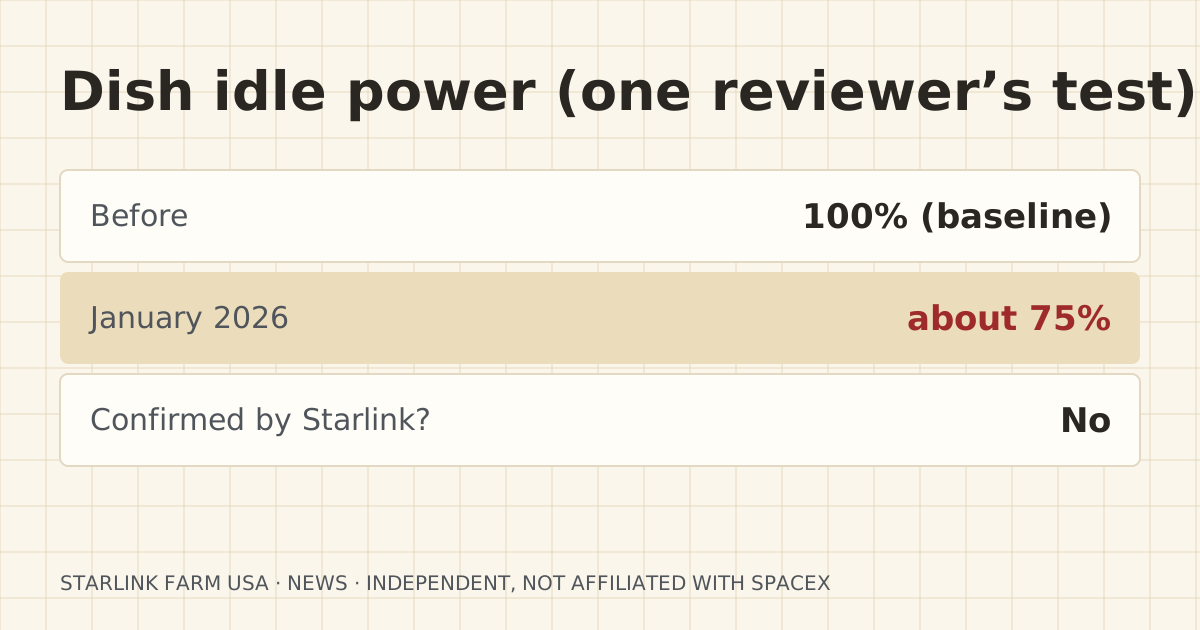
DISHYtech reported in January 2026 that its tests show Standard and Mini dishes idling at about 25% less power. One reviewer’s measurement, not a Starlink spec.
- Announced or first reported
- Effective
- Not announced by Starlink. Observed by one reviewer in January 2026.
- Published
- Last updated
What changed
DISHYtech, a long-running Starlink review site, posted on 2026-01-26: “My recent testing shows that Starlink reduced idle power consumption for the Standard and Mini antenna’s by around 25%.” The post goes with a video. Starlink did not announce the change, and we found no Starlink spec page that lists new idle figures.
This is an observation by one tester, not a confirmed spec. The post’s summary doesn’t give the measured watts, test setup or firmware version, so we can’t restate them.
| Item | Before | After | Source date |
|---|---|---|---|
| Idle power, Standard and Mini dishes | Earlier firmware | About 25% lower (DISHYtech’s measurement) | 2026-01-26 |
Who it affects
Anyone running a dish off solar or batteries: an off-grid shop, a camera site, a hunting camp. Idle power is what the dish draws when little data is moving, which is much of the day at a camera site that only uploads on motion.
What it means for your setup
If the measurement holds, an off-grid dish uses less energy overnight. That could mean a smaller battery or fewer cloudy-day failures. But size your system from Starlink’s published average power, not from one reviewer’s idle number. Our gate and well camera guide covers camera-side power and links out for sizing the dish’s own solar.
For many remote camera spots, the bigger saving is not putting a dish there at all. A bridge from a building that already has internet draws only a few watts at each end.
Why idle power matters more than peak power on a camera site: a dish there spends most hours moving little data, so the overnight draw sets how big the battery must be to reach morning. Even a modest change in idle draw adds up across a long winter night. But a single tester’s result can depend on firmware, weather, heater use and the meter used. Until Starlink publishes figures, or until our own gear tests log the dish we use, treat a 25% cut as a hint to re-measure, not a number to design around.
What to do now
- If you run a dish on batteries, compare your own power logs before and after a firmware update. That beats any reviewer’s number for your setup.
- Keep sizing from Starlink’s stated average power for your dish model until Starlink publishes new figures.
What stays the same
- Starlink’s published average power ranges for each dish.
- Starlink Mini’s input range and USB-C PD requirement.
What we don’t know yet
- The exact before and after watts, and which firmware made the change.
- Whether the drop holds in cold weather, when Standard dishes run their snow-melt heaters.
Sources
- Video: Starlink Quietly Reduced Antenna Power By 25%, DISHYtech. Source date: 2026-01-26. Secondary. Retrieved 2026-10-06.
“My recent testing shows that Starlink reduced idle power consumption for the Standard and Mini antenna’s by around 25%.”
Corrections
No corrections since publication. Spotted an error? Tell us.