Plan rulesPress reportsBackgroundIndependent, not affiliated with SpaceX
Starlink renames its US home plans Residential Max, 200 Mbps and 100 Mbps
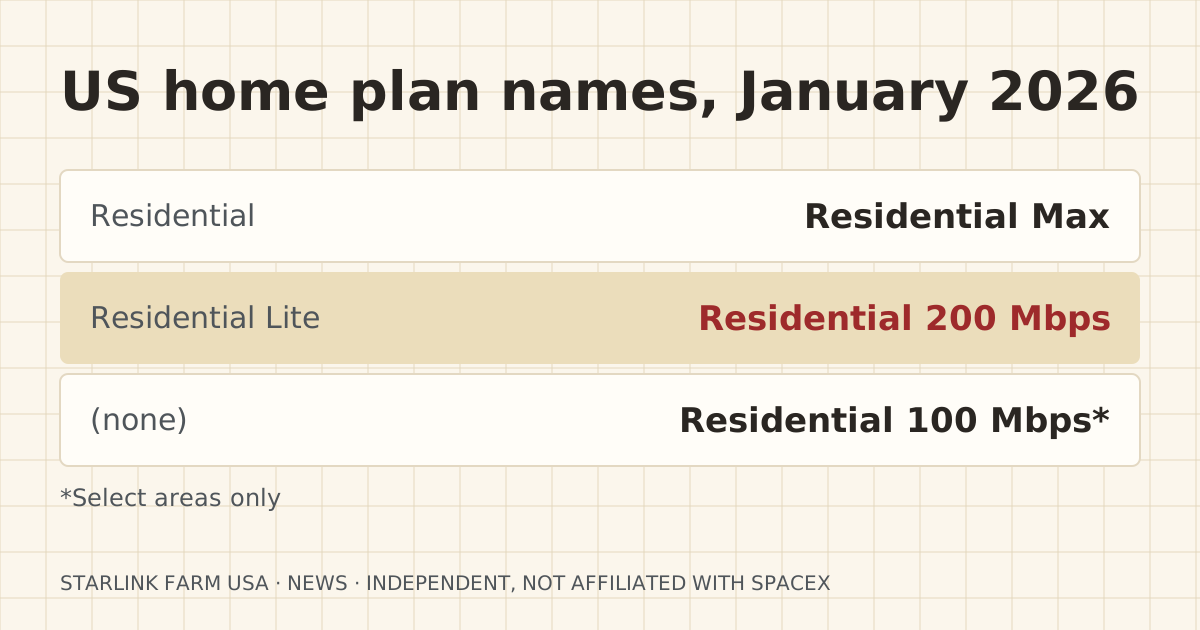
In January 2026 Starlink renamed Residential and Lite to Residential Max and 200 Mbps, and brought back a 100 Mbps plan in select areas. Farm angle on picking a tier.
- Announced or first reported
- Effective
- Published
- Last updated
What changed
SatelliteInternet.com reported on 2026-01-14 that Starlink renamed its Residential plan to Residential Max and Residential Lite to Residential 200 Mbps. It also brought back a 100 Mbps plan in select areas. All three come with unlimited data. Starlink’s customer wording, quoted in a DISHYtech comment, says Max gives “maximum speeds available—up to 400+ Mbps” and that speeds “are not guaranteed.”
At launch, the report says Max came with a free Router Mini and an optional rented Mini kit at half-price Roam. Prices at launch were $120, $80 and $50. They rose $5 to $10 in June 2026.
| Item | Before | After | Source date |
|---|---|---|---|
| Top home plan | Residential | Residential Max (up to 400+ Mbps, per Starlink) | 2026-01-14 |
| Lower plan | Residential Lite | Residential 200 Mbps | 2026-01-14 |
| Entry plan | None | Residential 100 Mbps, select areas | 2026-01-14 |
Who it affects
Anyone choosing a home plan for a farm house. The lower tiers are “select areas” only. Starlink offers them where it has spare capacity.
What it means for your setup
The tier you pick at the house sets the ceiling for everything downstream: the barn, the shop, the cameras. A 100 Mbps plan with, per Starlink, 20 Mbps upload in most states can carry a handful of HD cloud cameras plus normal use. Add up your cameras’ upload needs with our camera table before you pick the cheapest plan.
The barn link itself doesn’t care about the tier. A bridge pair or buried Cat6 carries far more than any of these plans.
A worked example using Starlink’s own lower-tier figure of 20 Mbps upload. Ring lists 2 Mbps for a 1080p camera and 10 Mbps for a 2K camera. Four 1080p cameras uploading at once use about 8 Mbps, leaving room for video calls. Two 2K cameras at once would use the whole 20 Mbps. Most cameras only upload on motion or when you open the live view, so real use is lower, but evening is when both people and cameras are busy. If you run a working yard with several cameras, start from the upload you need and pick the tier from that.
What to do now
- Add up camera upload before you choose. Several 2K or 4K cameras on a 100 Mbps tier will fight for upload in the evening.
- Check which tiers starlink.com offers at your address. Lower tiers aren’t offered everywhere.
What stays the same
- One Residential line per service address.
- CGNAT on all three tiers. Public IPv4 comes only with Priority plans.
What we don’t know yet
- Which areas get the 100 Mbps and 200 Mbps tiers. Starlink doesn’t publish a list.
Sources
- Starlink Starts 2026 With MAX and More New Plans, SatelliteInternet.com. Source date: 2026-01-14. Secondary. Retrieved 2026-10-06.
- Starlink network update (lower tier upload), Starlink. Source date: 2025-07-14. Primary. Retrieved 2026-10-06.
“Even Starlink’s lower speed tier offering currently serves customers with 100 Mbps download and 20 Mbps upload speeds in most states and territories.”
Corrections
No corrections since publication. Spotted an error? Tell us.